
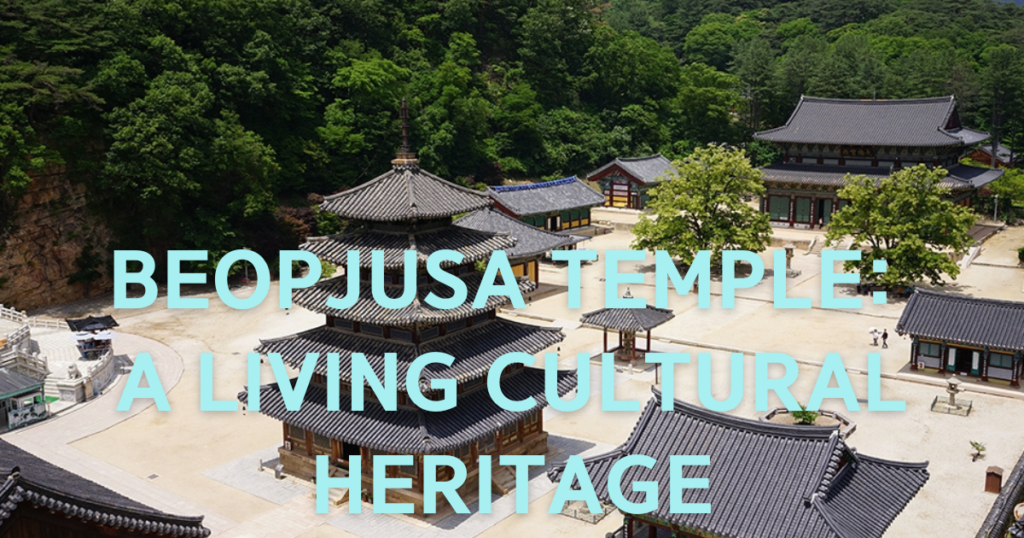
Beopjusa Temple is designated as Historic Site No. 503 of South Korea, and is home to a remarkable collection of cultural heritage — most notably Palsangjeon (National Treasure No. 55), the only surviving wooden pagoda in the country. In total, the temple holds 3 National Treasures, 12 Treasures, 21 Chungcheongbuk-do Tangible Cultural Properties, and 1 state-designated Cultural Heritage Material.
The name “Beopjusa” traces back to the monk Uisin, who journeyed to India in search of the Dharma. Upon returning with Buddhist scriptures carried on a white donkey, he settled here — and so the temple came to be known as “the place where the Buddha’s teachings dwell.”
The mountain embracing the temple, Songnisan, has long been celebrated as one of the Eight Scenic Wonders of Korea. Its fame rested not on natural beauty alone; the presence of Beopjusa was itself a reason the mountain was never left off any list of Korea’s great peaks.
National Treasures and Treasures of Beopjusa
1. Twin Lion Stone Lantern National Treasure No. 5
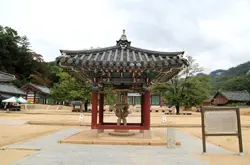
Believed to date to 720 AD, the 19th year of King Seongdeok’s reign during the Silla period, this octagonal stone lantern stands roughly ten feet tall. Its most striking feature is a pair of lions facing one another — their hind paws planted on a downward-facing lotus base, their front paws raised to support an upward-facing lotus stone above. The lions rest on an octagonal foundation, and the upper lotus stone is ringed with a double layer of carved petals. Regarded as a defining example of Silla-era lantern craftsmanship, it is widely considered one of the finest works of stone art to survive from that period.
2. Palsangjeon Pavilion National Treasure No. 55
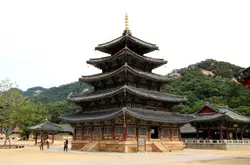
Palsangjeon stands as the only wooden pagoda still remaining in Korea. According to tradition, it was first built by Master Uisin at the time of the temple’s founding, then rebuilt by Master Jinpyo in the 12th year of King Hyegong’s reign during the Silla period. The structure was destroyed by fire during the Second Japanese Invasion, and restoration began in 1602 under Masters Samyeong and Byeokam, with the work completed in 1624, the second year of King Injo’s reign in the Joseon dynasty.
During dismantling and repair work in 1968, a reliquary was uncovered beneath the massive central pillar, shedding valuable light on the pagoda’s construction history. Inside, the four walls are adorned with eight paintings depicting the life of Sakyamuni Buddha across eight stages of his life. In front of each wall stands a Buddhist altar enshrining a main Buddha statue, soapstone votive figures, and Arhat statues.
3. Stone Lotus Fountain National Treasure No. 64
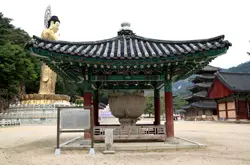
The Stone Lotus Fountain is believed to have been created around 720 AD, during the 19th year of King Seongdeok’s reign in the Silla period. Rising from an octagonal foundation stone, it features three-tiered supports, above which sits a stone carved with downward-facing lotus petals. On top of this rests a “child stone” sculpted in the form of clouds, which in turn cradles the lotus basin above.
Originally placed as a devotional ornament within Yonghwabojeon Hall — the former main hall of Beopjusa — the fountain is carved from granite and symbolizes the sacred lotus pond of the Pure Land. It is described as the “Sweet Dew Spring” of the nine-tiered lotus world, embodying eternal joy, boundless life, and the aspiration to guide all living beings toward enlightenment.
(Height: 1.95m, Circumference: 6.65m)
4. Stone Lamp of the Four Heavenly Kings Treasure No. 15
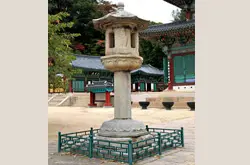
Dating to around 720 AD, the 19th year of King Seongdeok’s reign, this stone lantern represents the classic octagonal pillar form that defines the standard style of Korean stone lanterns. Standing 3.9 meters tall, it is composed of six elements stacked in sequence: a foundation stone, lower base, middle pillar, upper support, light chamber, and roof stone. The lantern takes its name from the four guardian deity figures — the Four Heavenly Kings — carved onto each face of the light chamber, which forms the most prominent and visually significant part of the structure.
5. Rock-carved Seated Buddha Treasure No. 216
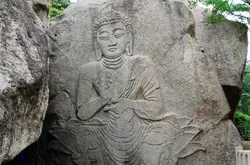
This Buddha image is carved directly into the face of Churaeam cliff, situated beside the Sarigak relic hall. Rather than striving for naturalism, the figure carries a distinctly abstract quality — a broad, rounded face, eyes that appear neither fully open nor fully closed, full lips, squarely set shoulders, and a waist that narrows to an unusually slender point. The lotus throne wraps the figure in a ring of lotus petals, while at the base, a half-finished lotus-patterned stone rests on the ground beneath the feet, as though still emerging from the rock.
(Total height: 6.18m)
6. Daeungbojeon Hall Treasure No. 915
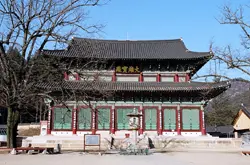
Daeungbojeon is an imposing two-story structure built on a low platform, first established by Master Uisin in 553 AD during the reign of King Jinheung of Silla, and later rebuilt by Master Byeokam in 1624. With 120 sections, a floor area of 170 pyeong, and a height of approximately 20 meters, it ranks among the grandest wooden buildings in the country.
Inside, three clay Buddha statues are enshrined — known collectively as the Clay Seated Buddha Triad, the largest of their kind in Korea, with a seated height of 5.5 meters and a waist circumference of 3.9 meters. The central figure is Vairocana, the Dharma Body Buddha, representing the mind. To the left stands Rocana, the Reward Body Buddha, representing virtue cultivated through wisdom and practice. To the right is Sakyamuni, the Emanation Body Buddha, representing the physical form. Though the Buddha is fundamentally one, he is enshrined in three aspects to make his nature more accessible and easier for us to understand.
7. Wontongbojeon Hall Treasure No. 916
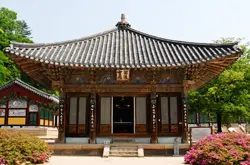
Wontongbojeon traces its origins to the founding of Beopjusa, when Master Uisin first erected the hall. It was rebuilt by Master Jinpyo in 776, and after being lost to fire during the Imjin War, restored once more by Master Byeokam in 1624. Distinctive in its square floor plan, the building is considered a fine expression of the refined and elegant architectural sensibility of the mid-Joseon period.
Inside, a large Wooden Seated Avalokitesvara Bodhisattva — Treasure No. 1361 — is enshrined, its face radiating a quiet and boundless compassion.
8. Hanging Painting / Gwaebul Taenghwa Treasure No. 1259
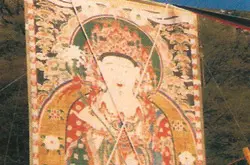
Created in 1766, the 42nd year of King Yeongjo’s reign, this monumental Buddhist banner painting measures 14.24 meters in length and 6.79 meters in width. Across its vast canvas, vibrant floral patterns and five-colored clouds sweep around the central figure of Maitreya Buddha, lending the composition a sense of grand, ceremonial splendor. The Buddha is depicted bearing a circular halo and body light, with a branch of the Yonghwasu tree held in one hand. The painting is brought out and displayed during Yadanbeopseok — large-scale outdoor Buddhist ceremonies. Records indicate it was produced by a team of 14 monks, led by the head painter-monk Juhun.
9. Iron Pot Treasure No. 1413
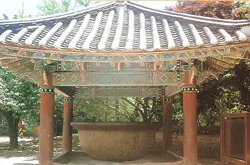
This enormous iron pot, standing 1.2 meters tall with a diameter of 2.87 meters, is said to have been cast during the reign of King Seongdeok of Silla. Two stories surround it: one holds that it was used to boil soup for as many as 30,000 devotees at a time, while another recalls that monk-soldiers made use of it to feed their troops during the Imjin War. Either way, its sheer scale speaks to the vitality and scale of Beopjusa at its height.
Templestay Programs
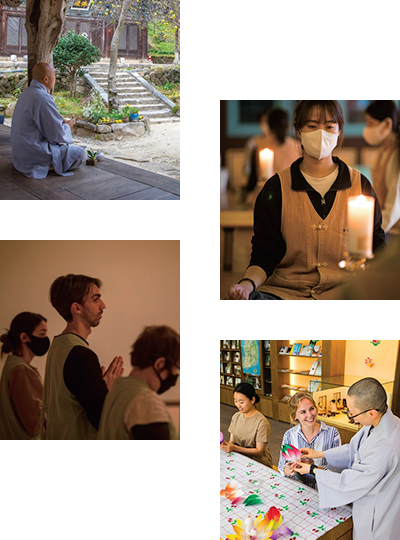
1. Day-stay
Designed for those unable to spend the night, including visitors with limited time. Participants can choose from a range of activities such as a guided temple tour, sitting meditation, a traditional tea ceremony, and hands-on crafts like lantern-making, prayer bead stringing, or sutra transcription.
2. Experiential Stay
An immersive program centered on traditional Buddhist culture and monastic life. Activities include learning proper temple etiquette, Baru Gongyang (the formal communal meal using monks’ bowls), 108 prostrations, lantern-making, and visits to the temple’s historic cultural sites.
3. Relaxation Stay
A program designed for those seeking genuine rest in a natural setting. Beyond the daily ceremonies and communal meals, participants are given ample free time to slow down, breathe in the surroundings, and quietly restore their energy through meditation and time spent in nature.
Introduction to Major Programs
01. Temple Tour
A temple pilgrimage is more than a visit to a religious site — it is a journey through a living tradition. You will discover the meaning and beauty behind the temple’s architecture, sculpture, crafts, and Dancheong paintwork, all of which carry the teachings of the Buddha across generations.
02. Seon (Zen) Practice & Meditation
Silent Contemplation — Seon Practice: Seon is the heart of Korean Buddhist practice. Stepping away from the rhythms of daily life and turning inward, participants often find a renewed sense of clarity and quiet strength.
Awakening of the Body — Meditation: Steve Jobs, Michael Jordan, John Lennon, and Richard Gere all shared one habit: a regular meditation practice. The temple’s natural surroundings — clean forest air, flowing valleys, and deep stillness — offer ideal conditions to settle the senses and arrive fully in the present moment.
03. Tea Talk with a Monk
Sitting down with a monk over a warm cup of tea is one of the most cherished moments of any Templestay. There is no fixed topic — you are welcome to ask about Buddhist culture, or simply share whatever is weighing on your mind. Many guests look back on this quiet conversation as the most meaningful part of their stay.
04. Baru Gongyang
Baru refers to the traditional wooden bowls carried by monks. Eating a meal using these bowls, following the ritual form passed down through generations, is called Baru Gongyang. It is a practice rooted in gratitude — for the hands that grew and prepared the food, for nature’s generosity — and in mindfulness, ensuring that not a single grain goes to waste.
05. Yebul — Chanting Ceremony
Yebul marks the beginning and end of each day. Before dawn, the deep resonance of the temple bell stirs the mountain to life, and the day opens with the monks’ chanting. At dusk, the bell rings again, and all gather in prayer. It is a rare and moving opportunity to offer prayers for peace — with body, voice, and mind together.
06. 108 Prostrations
Each bow is an act of letting go — releasing one of the 108 worldly agonies that cloud the mind. Through repetition and physical effort, the practice becomes a form of honest self-reflection, cultivating humility and making room for new intention.
07. Making Lotus Lanterns & Prayer Beads
Lotus Lanterns: Shaped like the lotus flower, these lanterns are assembled petal by petal from folded paper. Just as the lotus rises clean and radiant from muddy water, making one is an expression of the wish to move toward wisdom and clarity.
Prayer Beads: Each bead is strung with a quiet prayer. A full strand holds 108 beads, one for each agony to be released. Rolling the finished beads between your fingers, you may notice the restless mind gradually settling into a single, steady point of focus.
What to Bring
Shampoo, conditioner, toothbrush, facial cleanser, hair dryer, towel, and a change of clothes. Soap and toothpaste are usually available at the temple, and a vest and pants are typically provided upon arrival — though items vary by temple, so check when booking. Mountain temples can be cool in the mornings and evenings outside of midsummer, so a cardigan or light jacket is recommended.
Templestay Q&A
1. Is it safe for solo travelers?
Templestay facilities are managed directly by the temple. All rooms are key-accessed and lockable from the inside, and entry by outsiders is restricted after 10 PM. Staff remain on-site at all times to respond to any situation, so solo guests can feel completely at ease.
2. Can I bring my child?
Children are generally welcome when accompanied by a parent or guardian, though policies differ by temple — it’s worth calling ahead to confirm. During school holidays, some temples also offer dedicated youth retreat programs.
3. Do I have to take part in everything?
All activities are voluntary. If you are unwell, or if certain programs feel too demanding, it is perfectly fine to sit them out. If 108 prostrations conflict with your beliefs, you are welcome to simply sit quietly. That said, each practice offers something genuinely worth experiencing — and the 4 AM dawn service, in particular, is something we encourage no one to miss.
4. What is the basic etiquette at a temple?
Loud noise, alcohol, and smoking are not permitted. Please also keep physical affection understated. The standard resting posture is Chasu — right hand resting lightly over the back of the left, held at the waist. When seated during a ceremony, cross your legs with the right foot tucked beneath the left. When passing a monk outdoors, pause and offer a half-bow with palms pressed together. Indoors, one or three bows are appropriate.
5. How should I behave inside a Dharma Hall?
Pause at the entrance and offer a half-bow toward the altar before entering or leaving. Use the side doors — the center door is reserved for monks — and avoid sitting in the very center of the hall for the same reason. Speak softly, and when someone is praying or bowing nearby, always pass behind them, never in front.
Reservation and Contact Information
👉Direct Link to Beopjusa Templestay Reservation 👈
Address : 405 Beopjusa-ro, Sokrisan-myeon, Boeun-gun, Chungcheongbuk-do
Phone : 043-543-3615
핑백: Top 10 Representative Temples of Chungcheong-do, Korea - oysworldpost.com